
Numerical Reasoning
Your highest score today: top 3% of Class 6.
52 min · every question written and normed for Class 6 · nothing to pass or fail. From CareerGuide.com.
Free to take — pay only for the full report

📖 IQ Assessment for Class 6 · the report
Flip through every page of a real IQ Assessment sample report — the same pages your child's report carries.
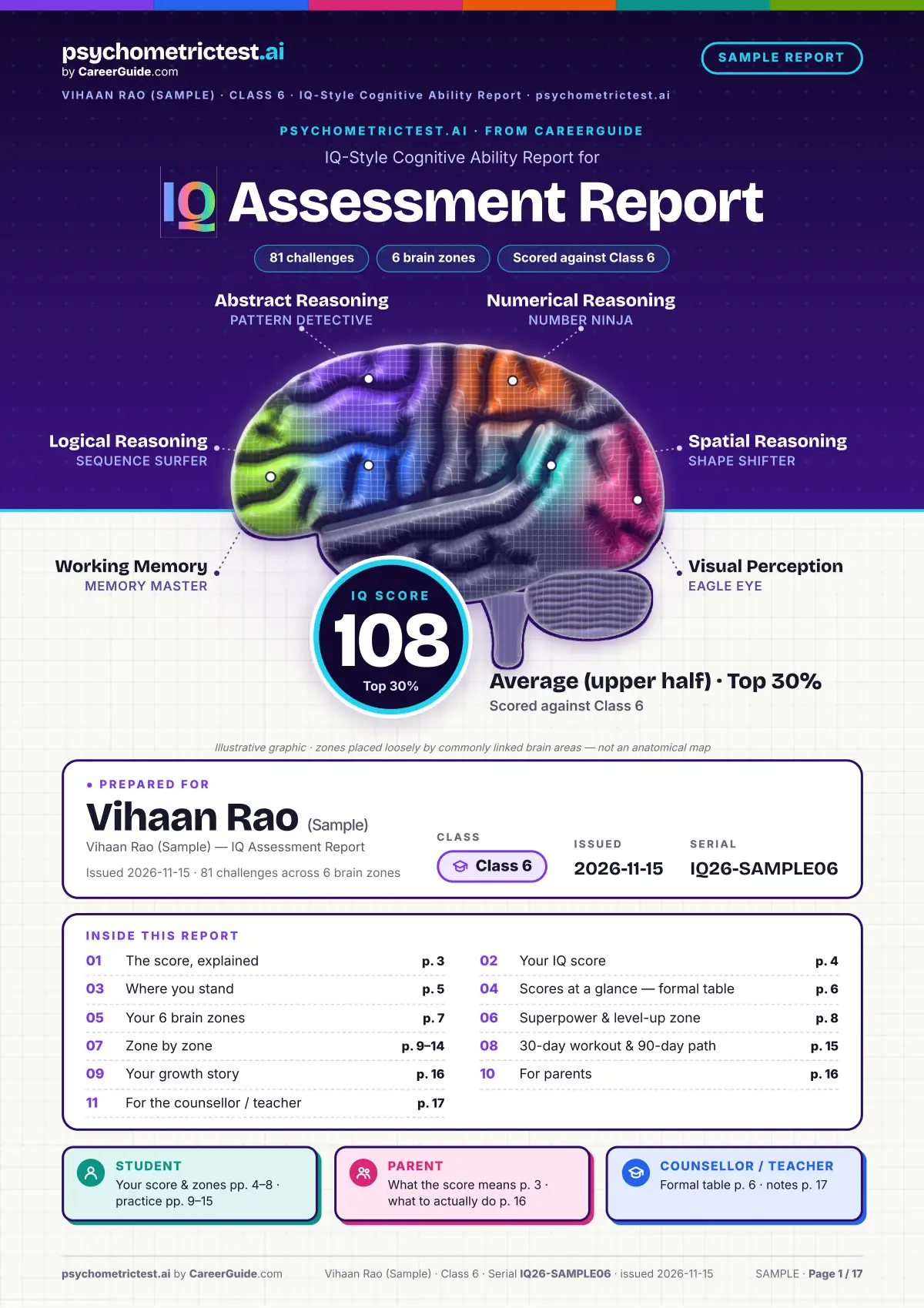
Tap the page or swipe to turn it · Zoom to read it full size
Written for the student — strengths first, in words they can use about themselves.
Your highest score today: top 3% of Class 6.
Still higher than 25 of every 100 Class 6 students. Not a weakness — simply the ability where practice pays fastest.
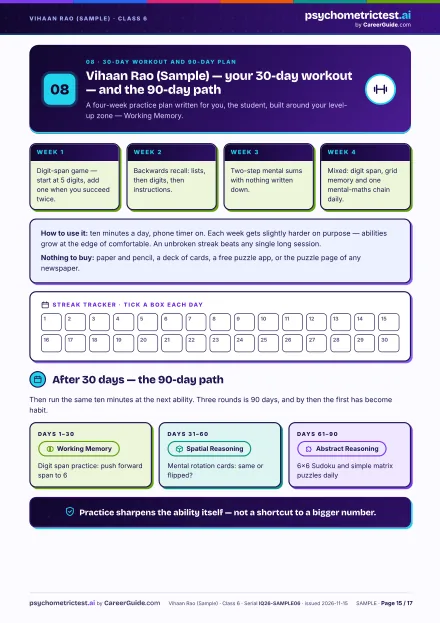
A four-week plan built around Working Memory — then the 90-day path. Nothing to buy.
For the parent — the number, what it means, and what it does not measure.
Average (upper half): top 30% of Class 6. From one sitting, the true level almost certainly falls inside that range.
Creativity · Kindness · Humour · Leadership · Effort · Curiosity · Talent.
Puzzles, chess, reading, music and proper sleep all help.
For the counsellor or teacher — the whole picture in one line, and when to check in.
Overall: Average (upper half) for Class 6.
Each number is how many students out of 100 in Class 6 this result is ahead of.
Ask about the practice plan on day 15 and day 30.
A sample child with made-up answers, scored exactly as a real Class 6 report is.
No sound — the words are on screen.
See how your child actually thinks. How they spot patterns. How they think in steps. How they turn shapes in their mind. How they hold things in mind. Mostly picture puzzles. Tap the one that fits. A phone shows a row of shapes and asks “What comes next?”, with picture answers to tap; one tap marks an answer, and Next brings the next puzzle. Never just one number — the report card shown is a sample: an IQ score with its likely range, and each thinking area as a bar, from Strong to Growing. Strengths first. Written for their own class. Nothing to pass or fail. IQ Assessment — Classes 3–12, ages 8–18. Start your assessment — psychometrictest.ai by CareerGuide.com.
⏰ Why Class 6
Middle school is when styles and interests stabilise — the first trustworthy signal.
A dip usually means method mismatch, not ability. This shows which one.
Strengths first, in encouraging words — every score compared only with their own class, never a pass or fail.
🎯 What it measures
Spotting what comes next
Numerical reasoning for their age
Shapes, rotation, visual logic
Working memory games
📖 The report
⚙️ How it works
The Class 6 paper has 81 questions with a short break midway — every one written and normed for Class 6. Each question lands in one of six zones:
How it works
The five reasoning zones count about equally; working memory adds roughly half a zone's share. Together they become one strengths profile — honest ranges, never a single label.
What the report gives you
IQ Assessment — strengths profile · Class 6 sample
Bell curve · the likely range is shaded, never one fixed point
Serial IQ-2026-●●●● · verifiable online
Every parameter we measure
The Class 6 paper draws every question from these same six zones — the parameters never change by class, only the level does.
In the report: Abstract Reasoning
In the report: Logical Reasoning
In the report: Visual Perception
In the report: Numerical Reasoning
In the report: Spatial Reasoning
In the report: Working Memory
Every zone runs from easy to very hard, and each class paper draws its own fixed share from every level — so two students in the same class always face an equally hard paper.
🎯 Why this class
The profile shows which zones carry that new load — patterns, sequences, spatial, numbers, visual detail, working memory — and which one needs propping up first.
81 questions, written and normed for Class 6, tell a student whether re-reading, drawing it out or self-testing actually suits the way they think.
A six-zone profile separates the student who finished early because it was easy from the one who guessed — and gives a teacher one specific line per parent.
📦 What you walk away with: all six zones ranked with the strongest named first, an honest likely range on the standard IQ scale and where it sits on the bell curve, the formal table a school can read, a brain map of the six zones and a page for each zone with practice ideas, a 30-day workout, a page for parents and one for the counsellor, and a certificate with a serial anyone can verify.
🗓️ When & why
Does this sound familiar?
“Six subjects, six teachers — and suddenly homework runs till nine.”
The profile shows how your child holds and organises information — working memory and sequential reasoning — so the new routine is built around it, not against it.
“A new batch of Class 6s from five primary schools. Who needs a bridge, and in what?”
A six-zone profile per student lets you group them for reasoning practice in the first month — before the first unit assessment tells you the hard way.
You always spotted the pattern first in class. Now the questions are longer, and that trick isn’t enough.
The psychometric assessment shows what else you are good at — space, numbers, memory, detail — and which one to train so long questions feel short again.
The right moments
New subjects, new teachers, more homework. A profile now shows how you think before the workload decides for you.
Olympiads and quiz teams start to matter in Class 6. Pick the ones that play to a real strength — the report names it.
A dip after primary school is common. The profile shows parents whether it is a method problem, not an ability problem.
⏱️ Why now, not later: middle school sets the study method for the next four years. Know how you think in Class 6 and the method fits — find out in Class 8 and you are undoing habits.
Once a year is enough. Next year's paper is new, written for Class 7, and every score is still compared only with their own class.
Start the IQ Assessment · Class 6 ➜💰 Simple pricing
For trying any one live psychometric assessment.
Full psychometric assessment · complete report · certificate. Free to take — pay only for the full report.
For understanding the report with an expert.
The full report plus a 45-minute video call with a CareerGuide.com counsellor — your questions answered, the report analysed with you.
School or coaching batch? Bulk pricing → · Full details on pricing.
📄 A sample of your report
Four of the pages every Class 6 IQ Assessment report carries — the same layout your child's real result is printed in.
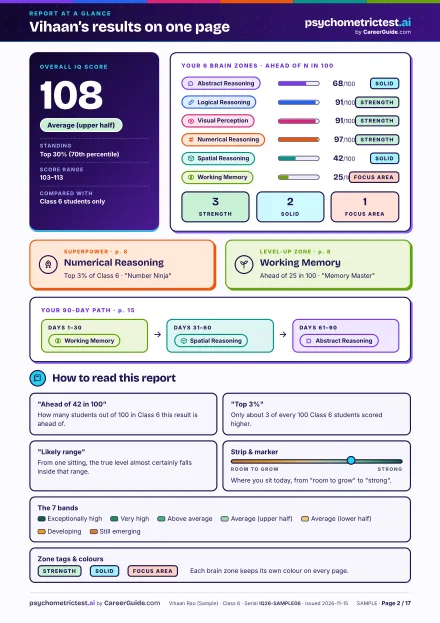 SAMPLE
Result at a glanceYour score + the six brain zones
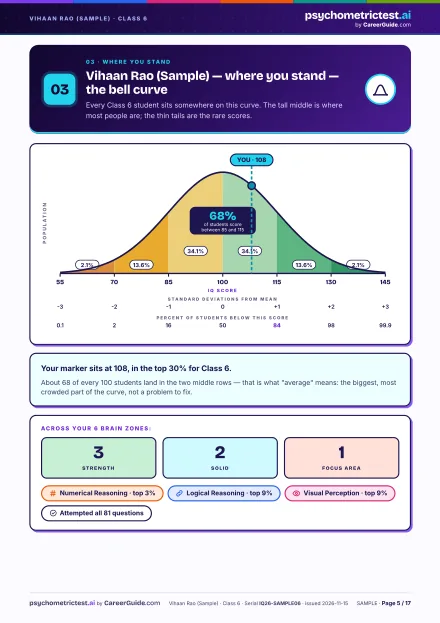 SAMPLE
Where you standThe bell curve, the likely range shaded
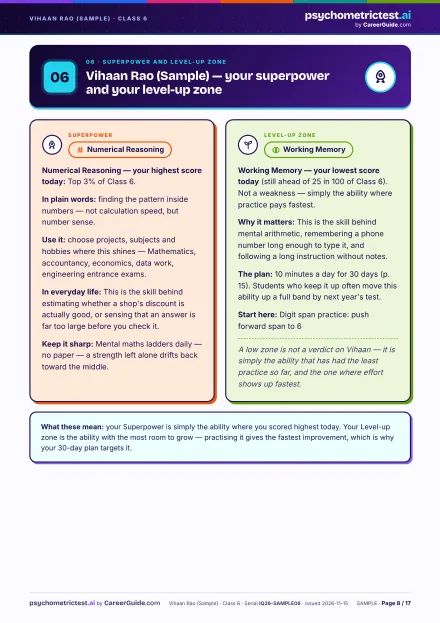 SAMPLE
Superpower + level-up zoneYour highest and fastest-growing
 SAMPLE
Your 30-day workoutThen the 90-day path
Also inside: A page for each of the six brain zones · For parents — what to actually do · For the counsellor / teacher · Certificate with a serial you can verify online.
Dummy data shown — your report carries your child's real profile.
💬 From their videos
Real families, on camera, from CareerGuide’s own channel — press play and hear it from them.
In the video: a parent speaks after a CareerGuide session at their child's school.
In the video: more from the same school session, part two.
In the video: taking the psychometric assessment and a counselling session in Class 10, and where it led.
Free to take — pay only for the full report · saves automatically.
Start the IQ Assessment · Class 6 ➜Schools and institutions that run CareerGuide.com assessments with their students.


















🤔 Common questions
It has 81 questions across six reasoning zones, with a break after question 25 and about 52 minutes in all. It is built for a Class 6 student to sit alone on a laptop or tablet; you only need to keep those minutes free of interruptions. The clock freezes at the break and pauses if they stop for a minute.
Six subjects and six teachers arrive at once, and the method that worked in Class 5 may not fit any more. The profile shows which zones carry the new load and which one needs propping up first, so the new routine can be built around how your child thinks.
At the start of middle school, before the workload decides for your child. Before olympiad and quiz-team sign-ups, so they choose ones that play to a real strength. Or if marks dip after the jump, to see whether it is a method problem rather than an ability problem.
Usually not. A dip after the jump to Class 6 is common, and it often means the study method no longer fits rather than that ability has changed. The six-zone profile shows which, and which zone to practise first.
An IQ score with its likely range and place on the bell curve, compared only with Class 6 students in India, and all six zones ranked with the strongest named first. Your child sees their strengths in encouraging words, and you get a page of what to do, a 30-day workout and a certificate with a serial anyone can verify.
A new Class 6 batch often arrives from several primary schools, and nobody knows who needs a bridge. A profile per student lets a teacher group them for reasoning practice in the first month, before the first unit assessment shows it the hard way. It also separates the student who finished early because it was easy from the one who guessed.