
Abstract Reasoning
Your highest score today: top 7% of Class 4.
30 min · every question written and normed for Class 4 · nothing to pass or fail. From CareerGuide.com.
Free to take — pay only for the full report

📖 IQ Assessment for Class 4 · the report
Flip through every page of a real IQ Assessment sample report — the same pages your child's report carries.
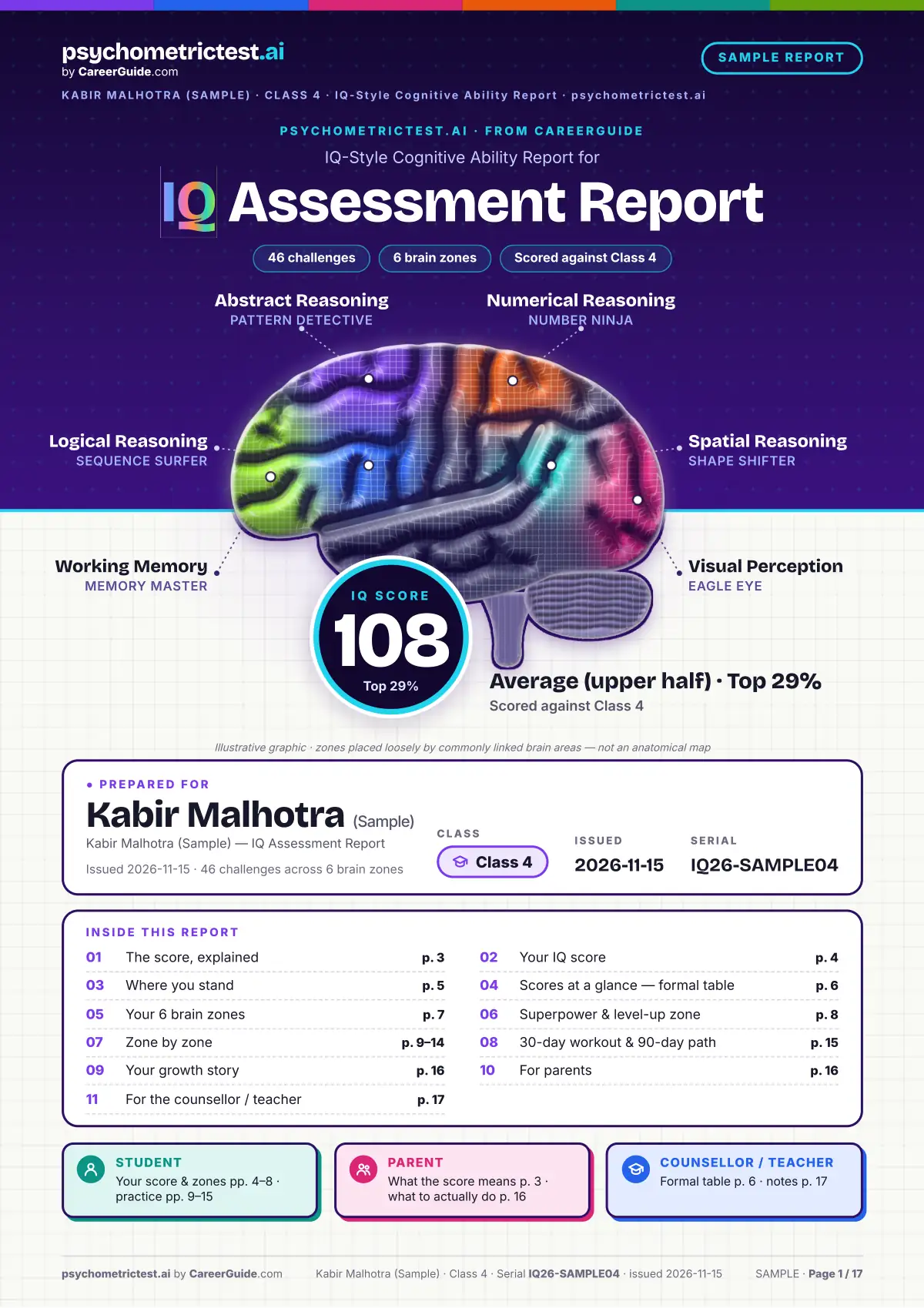
Tap the page or swipe to turn it · Zoom to read it full size
Written for the student — strengths first, in words they can use about themselves.
Your highest score today: top 7% of Class 4.
Still higher than 37 of every 100 Class 4 students. Not a weakness — simply the ability where practice pays fastest.
A four-week plan built around Spatial Reasoning — then the 90-day path. Nothing to buy.
For the parent — the number, what it means, and what it does not measure.
Average (upper half): top 29% of Class 4. From one sitting, the true level almost certainly falls inside that range.
Creativity · Kindness · Humour · Leadership · Effort · Curiosity · Talent.
Puzzles, chess, reading, music and proper sleep all help.
For the counsellor or teacher — the whole picture in one line, and when to check in.
Overall: Average (upper half) for Class 4.
Each number is how many students out of 100 in Class 4 this result is ahead of.
Ask about the practice plan on day 15 and day 30.
A sample child with made-up answers, scored exactly as a real Class 4 report is.
No sound — the words are on screen.
See how your child actually thinks. How they spot patterns. How they think in steps. How they turn shapes in their mind. How they hold things in mind. Mostly picture puzzles. Tap the one that fits. A phone shows a row of shapes and asks “What comes next?”, with picture answers to tap; one tap marks an answer, and Next brings the next puzzle. Never just one number — the report card shown is a sample: an IQ score with its likely range, and each thinking area as a bar, from Strong to Growing. Strengths first. Written for their own class. Nothing to pass or fail. IQ Assessment — Classes 3–12, ages 8–18. Start your assessment — psychometrictest.ai by CareerGuide.com.
⏰ Why Class 4
Picture-based questions, memory games that speak their instructions. Nothing to pass or fail — every score compared only with the child's own class.
Strengths spotted now get years of nurturing that a Class 9 discovery never gets.
Results go to you in plain language, with things to actually do at home.
🎯 What it measures
Spotting what comes next
Numerical reasoning for their age
Shapes, rotation, visual logic
Working memory games
📖 The report
⚙️ How it works
The Class 4 paper has 46 questions, played like a picture game with a break midway. Each one lands in one of six zones:
How it works
Every answer feeds one strengths profile for your child — honest ranges, never a single label.
What the report gives you
IQ Assessment — strengths profile · Class 4 sample
Bell curve · the likely range is shaded, never one fixed point
Serial IQ-2026-●●●● · verifiable online
Every parameter we measure
The Class 4 paper draws every question from these same six zones — the parameters never change by class, only the level does.
In the report: Abstract Reasoning
In the report: Logical Reasoning
In the report: Visual Perception
In the report: Numerical Reasoning
In the report: Spatial Reasoning
In the report: Working Memory
Every zone runs from easy to very hard, and each class paper draws its own fixed share from every level — so two students in the same class always face an equally hard paper.
🎯 Why this class
46 questions with a break midway, answered by looking rather than reading — so the result reflects reasoning and not reading speed.
Two children with the same report card can have opposite zone profiles; only the six-zone split tells you whether numbers, shapes or memory is doing the work.
Class 5 brings the middle-school jump, so a profile now buys a whole year of small practice before the workload rises.
📦 What you walk away with: all six zones ranked with the strongest named first, an honest likely range on the standard IQ scale and where it sits on the bell curve, the formal table a school can read, a brain map of the six zones and a page for each zone with practice ideas, a 30-day workout, a page for parents and one for the counsellor, and a certificate with a serial anyone can verify.
🗓️ When & why
Does this sound familiar?
“Finishes the maths sum in her head, then loses marks on the steps.”
Numerical reasoning is strong; sequential reasoning — showing each step — is the one to practise. The report separates the two so you stop drilling the wrong thing.
“‘Bright but distracted’ — I say it at every parent-teacher meeting (PTM) and can’t tell the parent what to actually do.”
The profile shows whether working memory or visual detail is doing the hiding. You get a one-line brief per child that parents can act on at home.
Rebuilds the LEGO set without the booklet, but the tables won’t stick.
Spatial reasoning ahead, working memory still growing — normal at nine. The 30-day plan shows which one to play with, ten minutes a day.
The right moments
Set the routine around your child’s real strengths while habits are still soft enough to shape.
Chess, abacus, art or coding? Pick at least one that stretches the growth zone the report names.
Bring a six-zone profile and leave with one plan the teacher and you both follow.
⏱️ Why now, not later: Class 4 is the cheapest year to steer study habits. Next year they harden, and Class 5 brings the middle-school jump.
Once a year is enough. Next year's paper is new, written for Class 5, and every score is still compared only with their own class.
Start the IQ Assessment · Class 4 ➜💰 Simple pricing
For trying any one live psychometric assessment.
Full psychometric assessment · complete report · certificate. Free to take — pay only for the full report.
For understanding the report with an expert.
The full report plus a 45-minute video call with a CareerGuide.com counsellor — your questions answered, the report analysed with you.
School or coaching batch? Bulk pricing → · Full details on pricing.
📄 A sample of your report
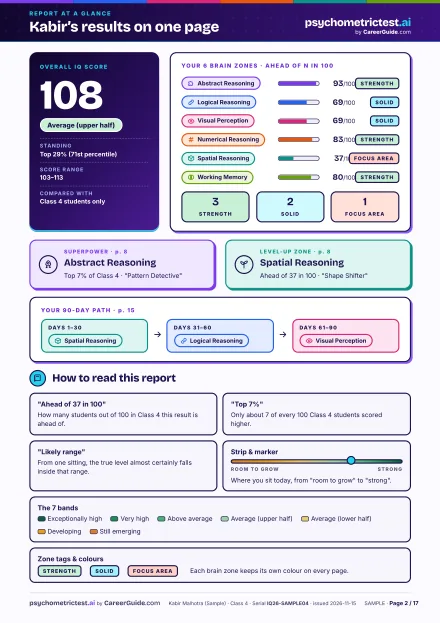
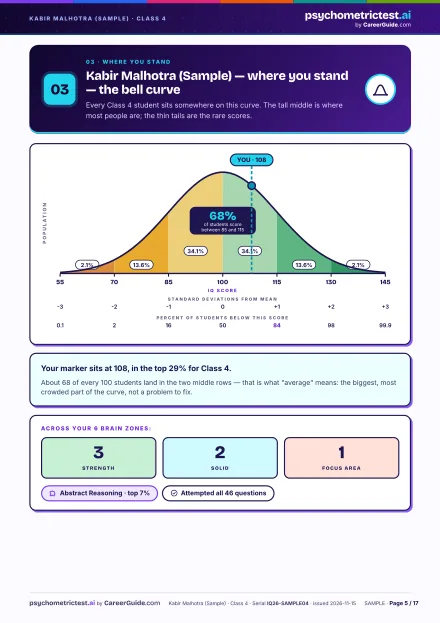
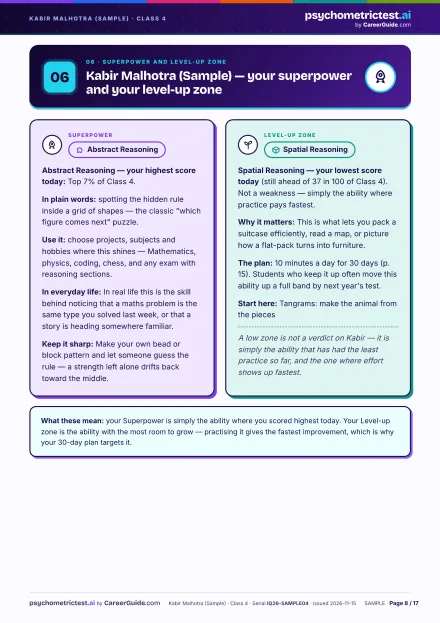
Four of the pages every Class 4 IQ Assessment report carries — the same layout your child's real result is printed in.
 SAMPLE
Result at a glanceYour score + the six brain zones
 SAMPLE
Where you standThe bell curve, the likely range shaded
 SAMPLE
Superpower + level-up zoneYour highest and fastest-growing
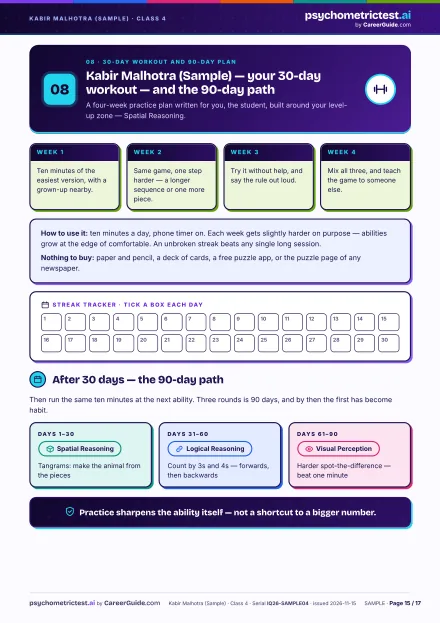 SAMPLE
Your 30-day workoutThen the 90-day path
Also inside: A page for each of the six brain zones · For parents — what to actually do · For the counsellor / teacher · Certificate with a serial you can verify online.
Dummy data shown — your report carries your child's real profile.
💬 From their videos
Real families, on camera, from CareerGuide’s own channel — press play and hear it from them.
In the video: a parent speaks after a CareerGuide session at their child's school.
In the video: more from the same school session, part two.
In the video: taking the psychometric assessment and a counselling session in Class 10, and where it led.
Free to take — pay only for the full report · saves automatically.
Start the IQ Assessment · Class 4 ➜Schools and institutions that run CareerGuide.com assessments with their students.


















🤔 Common questions
It has 46 questions across six reasoning zones, with a break after question 20 and about 30 minutes in all. It is still a picture paper, answered by looking rather than reading, so the result reflects reasoning and not reading speed. Sit nearby for the first few questions; a Class 4 child can usually do the rest alone.
Marks stop explaining everything around now: two children with the same report card can have opposite zone profiles, and only the six-zone split shows whether numbers, shapes or memory is doing the work. Class 4 is also the cheapest year to steer study habits, before Class 5 brings the middle-school jump.
At the start of the school year, while habits are still soft enough to shape. Before you pick activities such as chess, abacus, art or coding, so at least one stretches the growth zone the report names. And before the parent-teacher meeting, so you leave with one plan you and the teacher both follow.
It usually means strong numerical reasoning, with sequential reasoning (showing each step) still growing. The report separates the two, so you stop drilling sums and practise the steps instead.
"Bright but distracted" is easy to say at a parent-teacher meeting and hard to act on. The profile shows whether working memory or visual detail is doing the hiding, and gives a one-line brief per child that parents can act on at home.
An IQ score with its likely range and place on the bell curve, compared only with Class 4 students, and all six zones ranked with the strongest named first. It adds a brain map of the six zones and a page for each zone with practice ideas, a 30-day workout, a page for parents and one for the counsellor, and a certificate with a serial anyone can verify.