
The Connector
Brings people together — teams work better with you in them. Your strongest area: Interpersonal Skills.
~54 min · every question written for college life · compared with others at your level · Nothing to pass or fail. by CareerGuide.com
72 questions. 54 min. That is all it takes to map the 16 life skills no semester exam has ever given you a score for.
No sound — the words are on screen.
The skills schools teach but never measure. How they think. How they work with people. How they handle themselves. How ready they are for an AI world. Real-life situations — tap what you would really do. A phone shows an everyday situation with answers to tap; one tap, and the next one slides in. Every skill on one wheel — the wheel shown is a sample, and it fills in segment by segment. Strengths to build on. Skills to grow. Nothing to pass or fail. 21st Century Life Skills Assessment — Classes 3–12, ages 8–18. Start your assessment — psychometrictest.ai by CareerGuide.com.














⏰ Why now
Internships, placements, PG entrances — evidence now beats guesswork later.
Marks measure what you studied. This measures how you think, work with people and handle yourself.
2,500+ counsellors use these psychometric assessments — share the report in any session.
🎮 Don't read about it
No sign-up, no email · nothing to pass or fail
🧠 Cognitive Skills. How you think things through — decisions, problems, and checking what you hear before believing it.
Start the 21st Century Life Skills Assessment · Graduate ➜↑ Pick one — takes 10 seconds.
🎯 What it measures
Working with others
Working through problems
Original ideas
Handling change
📖 The report
⚙️ How it works
The graduate edition gives you 72 questions — real situations, best-answer checks and honest “that’s me” questions. Nothing to pass or fail. Each question lands in one of four skill areas:
How it works
Each area holds four skills — 16 in all, each scored 0 to 100. The strongest area becomes your strongest area, named in plain words.
What the report gives you
21st Century Life Skills Assessment — skills profile · sample
Stylised preview · scales run amber → green, never red · no ranks, no labels
Certificate included · every one carries a verification code
Every parameter we measure
The graduate edition has its own questions, but the map never changes — four areas, sixteen skills:
How the thinking happens
How you work with people
How you handle yourself
Real or AI-made — and what to trust
🎯 Why this edition
One of the four areas is AI Readiness: how ready you are for a world where AI is everywhere — telling real from AI-made, judging what to trust, staying safe.
Group discussions, interviews and internships look at how you decide, adapt and communicate — not only your CGPA.
Initiative, Persistence & Grit and Resilience & Coping carry you through projects, internships and a first job; nobody grades them and everybody notices them.
Sixteen scored skills give you one named strength and one honest focus area, in words you can actually say out loud.
You walk away with: your strongest of the four skill areas named in plain words, all 16 skills on one amber-to-green scale, one named strength and one focus area, six growth activities sized for college life, a page for you and a note for a mentor or professor — and a certificate with a verification code.
🗓️ When & why
Does this sound familiar?
🎓You
The placement panel asks 'tell us about a time you led something' — and your mind goes blank.The report names your real strengths across 16 skills, with the evidence behind them. Know your answers before the panel asks.
🧭A mentor or professor
Recommendation letters for the whole batch, and every student is 'hardworking, a team player' — in the same words.A scored profile across 16 skills gives specific, honest language for each letter, and one area the student is already working on.
🏛️A placement cell or training head
A whole batch heads into placements, and the soft-skills training is planned on guesswork.A scored, per-student profile across Cognitive, Interpersonal, Intrapersonal and AI Readiness shows which skills to train first.
The right moments
Group discussions, interviews and internship panels ask about exactly these skills — know your real answers.
One focus area fixed now is one less to fix in your first job.
Exams, projects and job hunting at once test grit daily — the report shows how you cope and what actually helps.
Why now, not later: College still gives you room to practise — clubs, projects, internships. A focus area fixed now doesn't follow you into your first job.
Once a year is enough. You're compared only with your own last score — never with anyone else.
Start the 21st Century Life Skills Assessment · Graduate ➜🌱 The wheel
Your psychometric assessment covers the whole wheel — think of it as a self-audit before placements.
Recruiters and interview panels read exactly these: Leadership, Communication, Adaptability. Knowing your strongest segments — with evidence — is an interview advantage.
📖 The report
Flip through every page of a real 21st Century Life Skills Assessment sample report. The sample shown is a Class 12 report; yours uses the same design, written for college life.
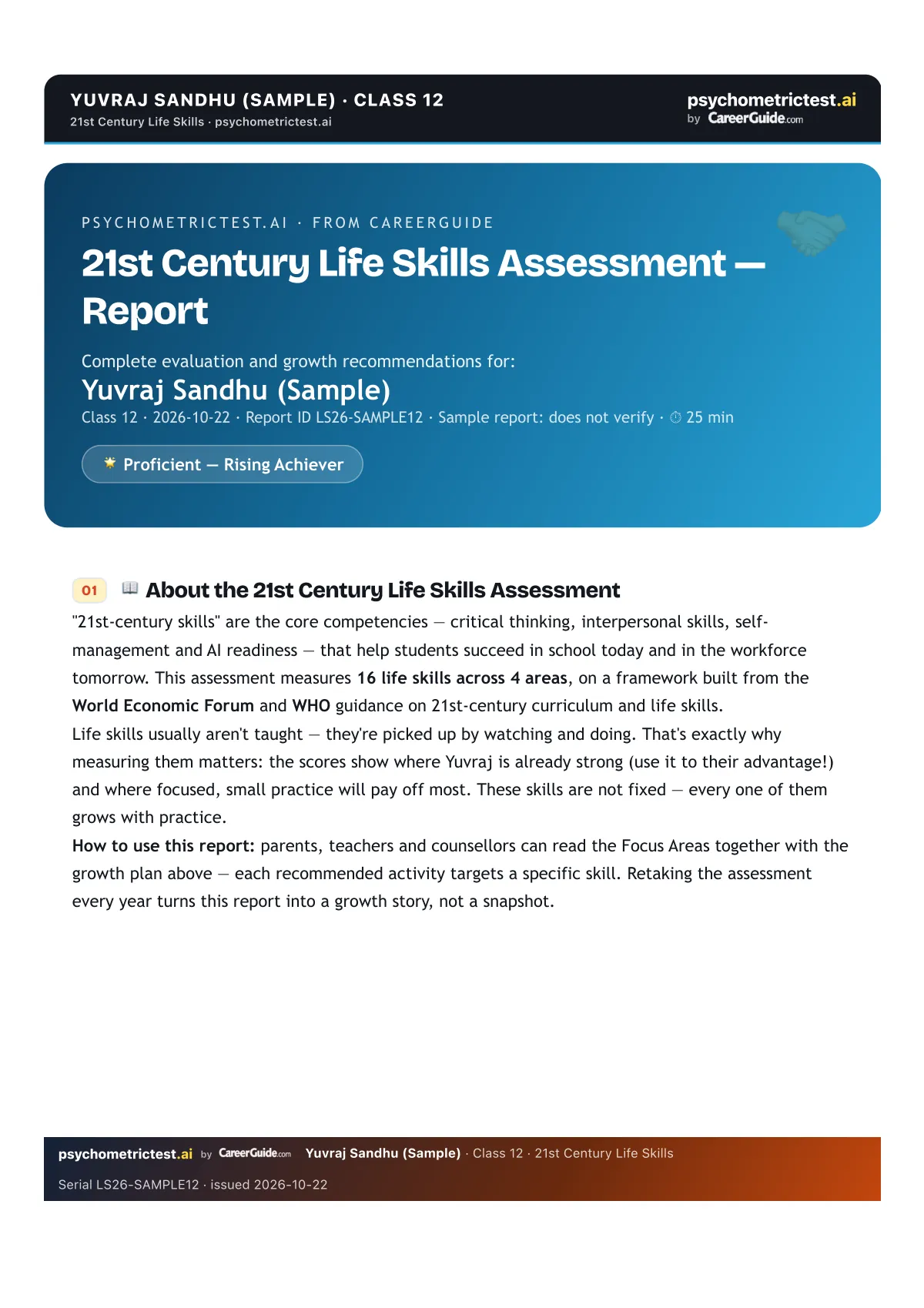
Tap the page or swipe to turn it · Zoom to read it full size
Written for the student — their type, their strongest skill and the one to grow.
Brings people together — teams work better with you in them. Your strongest area: Interpersonal Skills.
Almost everything big is built by teams. Being great to work with is a superpower.
Bouncing back — handling stress, disappointment and bad days without staying down.
For the parent — the overall level, what it means, and what to do at home.
Out of 100. A solid 21st-century skill set with one or two areas ready to level up. Strengthening the highlighted skills lifts the whole profile.
When they fail at something, share a failure of yours and what happened next. Modelled recovery beats pep talks.
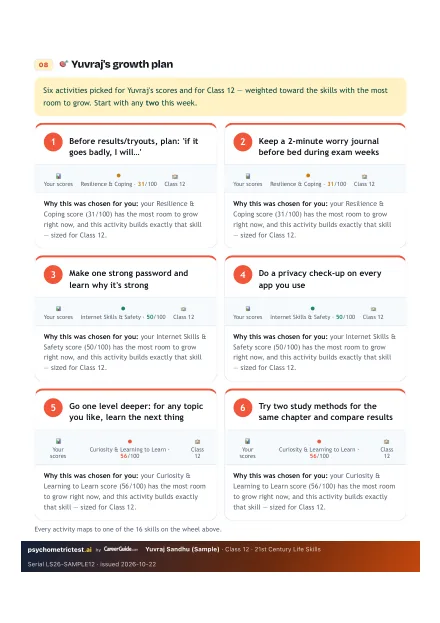
Picked for Yuvraj's scores — weighted toward the skills with the most room to grow. Start with any two this week.
For the counsellor or teacher — the four areas, the skill to focus on, and what to do in class.
All 16 skills, and where Yuvraj stands on each.
Stress and setbacks currently hit hard and stay long. This deserves gentle, consistent support — small wins, named feelings, trusted adults.
Normalise error — 'my favourite mistake' moments and visible redraft culture teach that setbacks are part of the work.
A Class 12 sample with made-up answers, scored exactly as a real report is.
💰 Simple pricing
21st Century Life Skills Assessment · Graduate
For trying any one live psychometric assessment.
Full psychometric assessment · complete report · certificate. Free to take — pay only for the full report.
What the report gives you
For understanding the report with an expert.
The full report plus a 45-minute video call with a CareerGuide.com counsellor — your questions answered, the report analysed with you.
College or placement batch? Bulk pricing → · Full details on pricing.
📄 A sample 21st Century Life Skills Assessment report (Class 12 sample)
Four of the pages, exactly as they appear in the real report.
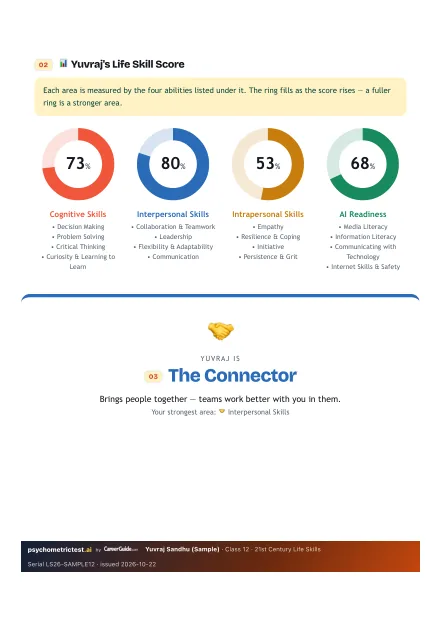 SAMPLE
Your archetype & overall levelTheir strongest area, named in plain words — and an Emerging → Advanced level
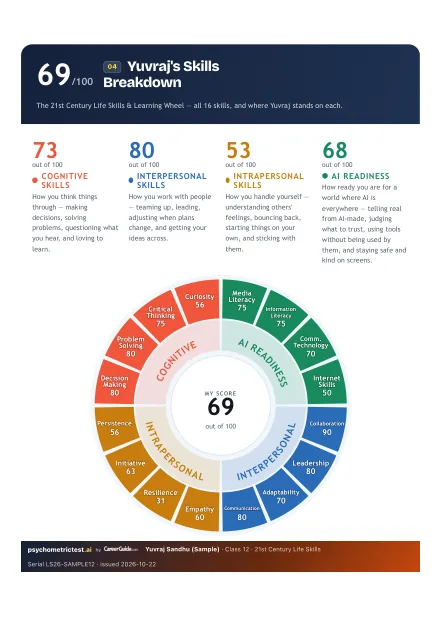 SAMPLE
Skills Breakdown — the Life Skills WheelThe 21st Century Life Skills & Learning Wheel: 4 areas, 16 skills
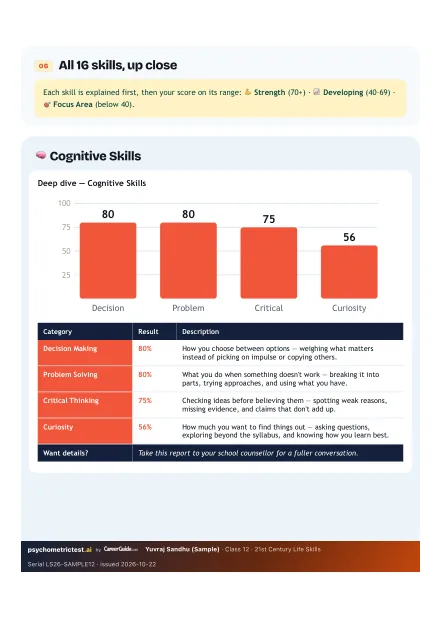 SAMPLE
All 16 skills, up closeA bar and a one-line read on every skill
 SAMPLE
Growth plan · for parents · for teachersActivities matched to the skills that need them, plus notes for both
Dummy data from a Class 12 sample — your report carries your own profile.
💬 In their words
Real students, on camera, from CareerGuide’s own channel — press play and hear it from them.
Took the assessment and a counselling session in Class 10 — and talks about where it led.
On taking the psychometric assessment, and the counselling session that followed.
Used the Stream Selector™ to settle her stream decision.
Planned her subject selection after the assessment.
🤔 Common questions
It has 72 questions, about 54 minutes, across 16 skills in four areas: think of it as a self-audit before placements. The questions are set in college life — projects, internships, placements, hostel life. You take it alone on a phone or laptop, and progress saves, so a second sitting is fine.
College students — undergraduate and postgraduate — and recent graduates. If you are already working, the working professional edition is written for working life instead.
Before placements and internship interviews, since group discussions and panels ask about exactly these skills. In final year or the year after, because a focus area fixed now does not follow you into your first job. And when exams, projects and job hunting pile up, to see how you are coping and what actually helps.
Yes. When a panel asks "tell us about a time you led something", you can answer from your real strengths across 16 skills, with the evidence behind them. The report gives one named strength and one honest focus area, in words you can say out loud.
Your strongest of the four skill areas in plain words, all 16 skills on one amber-to-green scale, and one strength and one focus area with six growth activities sized for college life. It also carries a note for a mentor or professor, and a certificate with a verification code.
A scored profile per student across Cognitive, Interpersonal, Intrapersonal and AI Readiness shows which skills a batch should train first, and gives mentors specific language for recommendation letters.
About 54 min, in your own time — it saves as you go, so you can stop and come back. No marks, no pass or fail. A wheel of 16 skills, and what to do about the lighter ones.
Start the 21st Century Life Skills Assessment · Graduate ➜