
The Connector
Brings people together — you read the room, and teams work better with you in them. Your strongest area: Interpersonal Skills.
~24 min · every question written for Class 3 · compared with Class 3 students in India · Nothing to pass or fail. by CareerGuide.com
32 questions. 24 min. That is all it takes to map the 16 life skills no exam has ever given Class 3 a score for.
No sound — the words are on screen.
The skills schools teach but never measure. How they think. How they work with people. How they handle themselves. How ready they are for an AI world. Real-life situations — tap what you would really do. A phone shows an everyday situation with answers to tap; one tap, and the next one slides in. Every skill on one wheel — the wheel shown is a sample, and it fills in segment by segment. Strengths to build on. Skills to grow. Nothing to pass or fail. 21st Century Life Skills Assessment — Classes 3–12, ages 8–18. Start your assessment — psychometrictest.ai by CareerGuide.com.

















⏰ Why Class 3
Picture-based questions, read-aloud support, smiley answers. Nothing your child can fail.
Strengths spotted now get years of nurturing that a Class 9 discovery never gets.
Results go to you in plain language, with things to actually do at home.
🎮 Don't read about it
No sign-up, no email · nothing to pass or fail
🧠 Cognitive Skills. How your child thinks things through — decisions, problems, and checking what they hear before believing it.
Start the 21st Century Life Skills Assessment · Class 3 ➜↑ Pick one — takes 10 seconds.
🎯 What it measures
Working with others
Working through problems
Original ideas
Handling change
📖 The report
⚙️ How it works
In the Class 3 psychometric assessment, your child meets 32 short questions — picture scenarios, best-answer checks and “that’s me” questions. Each one lands in one of four skill areas:
How it works
Each area holds four skills — 16 in all, each scored 0 to 100. The strongest area becomes your child's strongest area, named in plain words.
What the report gives you
21st Century Life Skills Assessment — skills profile · Class 3 sample
Stylised preview · scales run amber → green, never red · no ranks, no labels
Certificate included · every one carries a verification code
Every parameter we measure
Class 3 answers its own questions, but the map never changes — four areas, sixteen skills:
How the thinking happens
How they work with people
How they handle themselves
Real or AI-made — and what to trust
🎯 Why this class
One of the four areas is AI Readiness: how ready they are for a world where AI is everywhere — telling real from AI-made, judging what to trust, staying safe.
“Try again” and “ask before you believe it” are only forming now — Persistence & Grit and Critical Thinking still move with play, not lectures.
Class 3 is the earliest year we test, so every later year is measured against this one — never against another child.
Internet Skills & Safety and Media Literacy are scored from Class 3, because that is when screen habits actually start.
Your child walks away with: their strongest of the four skill areas named in plain words, all 16 skills on one amber-to-green scale, one strength and one focus area, six small growth activities sized for Class 3, a page for you and one for the teacher — and a certificate with a verification code.
🗓️ When & why
Does this sound familiar?
👨👩👧A parent
The block tower falls, the tears start, and the blocks go back in the box.The report shows how resilience and persistence are forming at eight — and gives you five-minute games that grow them.
🧑🏫A counsellor / teacher
Thirty Class 3s, one craft period — some share the scissors, some freeze when a step goes wrong.Every child's profile across the four skill areas plus a class pattern, so the next group activity is built on what they actually need.
🧒Your child
Asks 'why' forty times a day, but won't try a puzzle if it looks hard.Curiosity is already a strength — the report names it, and shows which small skill next to it is ready to grow.
The right moments
Class 3 is the earliest year we test — the first honest picture of how sharing, trying and bouncing back are forming.
If every setback ends in tears or a shutdown, the resilience and grit scores show what's underneath.
Take it early — the growth plan gives small habits the whole year to set.
Why now, not later: At eight, habits like 'try again' and 'ask before believing' are still soft. Named this year, they get a year of play to settle; next year they're a little harder to shift.
Once a year is enough. Your child is compared only with their own last score — never with another child.
Start the 21st Century Life Skills Assessment · Class 3 ➜🌱 The wheel
Your child's assessment covers this whole wheel — asked as small stories and pictures an 8-year-old enjoys.
At this age the wheel usually moves first in Curiosity, Empathy and small Decision Making moments at home. The AI Readiness quarter is just beginning — screen rules count as Internet Safety.
📖 The report
Flip through every page of a real 21st Century Life Skills Assessment sample report — the same pages your child's report carries.
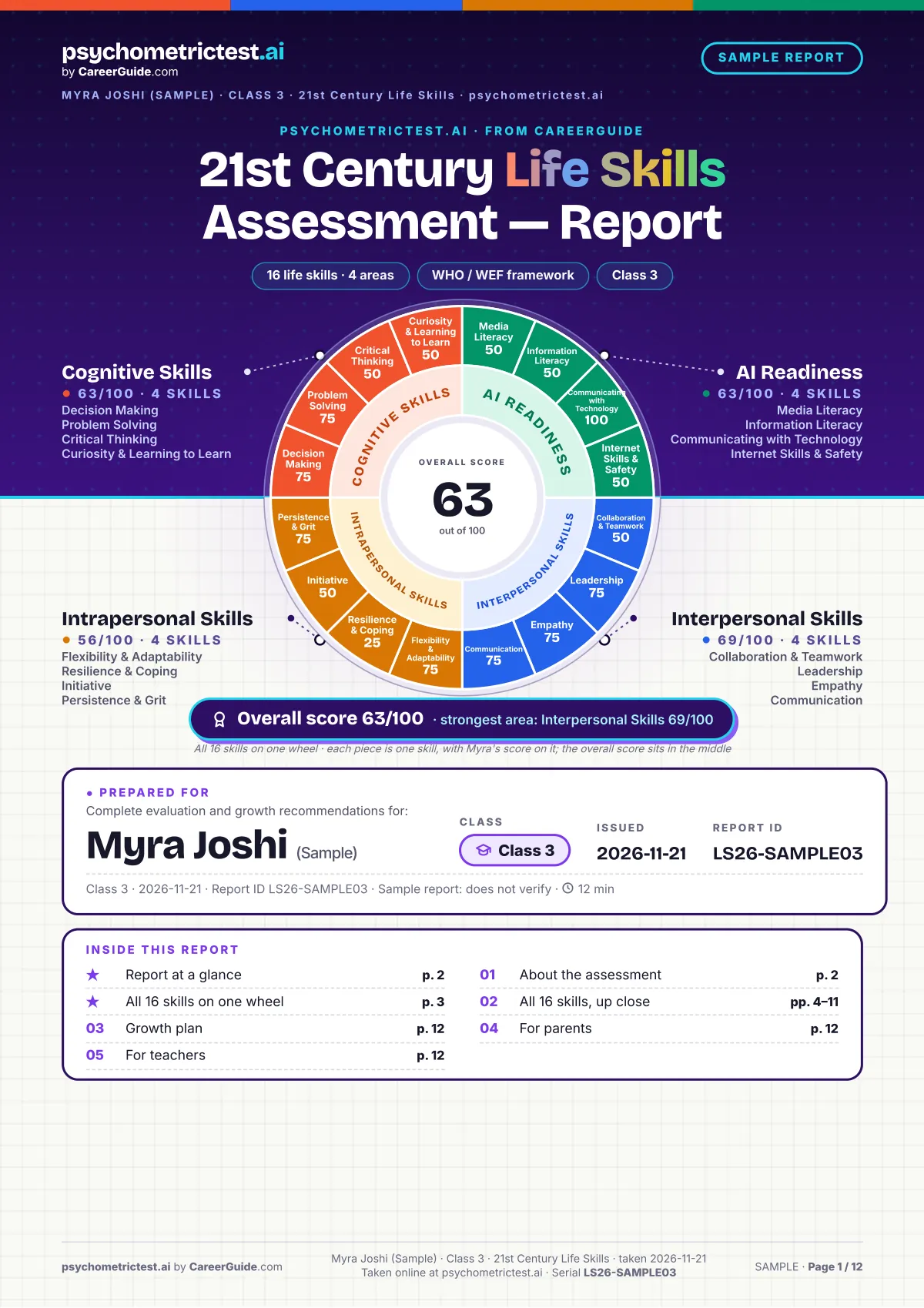
Tap the page or swipe to turn it · Zoom to read it full size
Written for the student — their type, their strongest skill and the one to grow.
Brings people together — you read the room, and teams work better with you in them. Your strongest area: Interpersonal Skills.
Online, your words ARE you. Digital communicators think before they type.
Bouncing back — handling stress, disappointment and bad days without staying down.
For the parent — the overall level, what it means, and what to do at home.
Out of 100. A solid 21st-century skill set with one or two areas ready to level up. Strengthening the highlighted skills lifts the whole profile.
When they fail at something, share a failure of yours and what happened next. Modelled recovery beats pep talks.
Picked for Myra's scores — weighted toward the skills with the most room to grow. Start with any two this week.
For the counsellor or teacher — the four areas, the skill to focus on, and what to do in class.
All 16 skills, and where Myra stands on each.
Stress and setbacks currently hit hard and stay long. This deserves gentle, consistent support — small wins, named feelings, trusted adults.
Normalise error — 'my favourite mistake' moments and visible redraft culture teach that setbacks are part of the work.
A sample child with made-up answers, scored exactly as a real Class 3 report is.
💰 Simple pricing
21st Century Life Skills Assessment · Class 3
For trying any one live psychometric assessment.
Full psychometric assessment · complete report · certificate. Free to take — pay only for the full report.
What the report gives you
For understanding the report with an expert.
The full report plus a 45-minute video call with a CareerGuide.com counsellor — your questions answered, the report analysed with you.
School or coaching batch? Bulk pricing → · Full details on pricing.
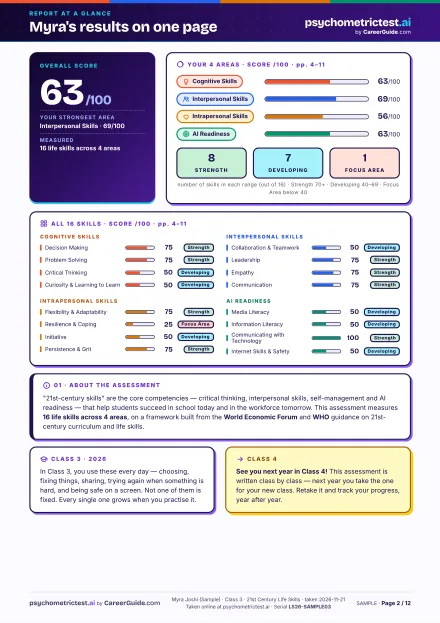
📄 A sample of your Class 3 21st Century Life Skills Assessment report
Four of the pages, exactly as they appear in the real report.
 SAMPLE
Your archetype & overall levelTheir strongest area, named in plain words — and an Emerging → Advanced level
 SAMPLE
Skills Breakdown — the Life Skills WheelThe 21st Century Life Skills & Learning Wheel: 4 areas, 16 skills
 SAMPLE
All 16 skills, up closeA bar and a one-line read on every skill
 SAMPLE
Growth plan · for parents · for teachersActivities matched to the skills that need them, plus notes for both
Dummy data shown — your report carries your child's real profile.
💬 In their words
Real families, on camera, from CareerGuide’s own channel — press play and hear it from them.
A parent speaks after a CareerGuide session at their child’s school.
More from the same school session, part two.
Took the assessment and a counselling session in Class 10 — and talks about where it led.
🤔 Common questions
It has 32 short questions, about 24 minutes, covering 16 life skills in four areas: thinking things through, working with people, handling themselves, and AI Readiness. They are asked as small stories and pictures an 8-year-old enjoys, and every question has a tap-to-hear button. Sit nearby for the first few, but let your child pick the answer.
At eight, habits like "try again" and "ask before you believe it" are only forming, and they still move with play rather than lectures. Class 3 is the first class this psychometric assessment is built for, so this result becomes the baseline every later year is read against.
At the start of the school year, so the growth plan gives small habits the whole year to set. Or when homework battles start: if every setback ends in tears or a shutdown, the resilience and grit scores show what is underneath.
Because the first tablet often arrives before the rules do. Internet Skills & Safety and Media Literacy are scored from Class 3, when screen habits actually start, and at this age simple screen rules count as internet safety.
Yes. It shows how resilience and persistence are forming at eight and gives five-minute games that grow them. It also names what is already strong, often curiosity or empathy at this age, so you know what to build on.
In a craft period, some children share the scissors and some freeze when a step goes wrong. The teacher gets each child's profile across the four skill areas plus a class pattern, so the next group activity is built on what the class actually needs.
About 24 min, in their own time — it saves as they go, so they can stop and come back. No marks, no pass or fail. A wheel of 16 skills, and what to do about the lighter ones.
Start the 21st Century Life Skills Assessment · Class 3 ➜